How to Auto-Train AI Agents (2026): Your Data, Indic Fine-Tunes & Synthetic Sets
To auto-train AI agents in 2026, close the loop on your own transcripts and tool logs: label failures, generate or mine training examples, fine-tune or adapt only where evals prove lift, and promote models behind a regression gate. For India, prioritize Indic and code-mixed data; use synthetic data to fill gaps—not to replace real calls. Blind fine-tuning without private evals usually makes agents sound confident and wrong.
Use this pillar as the map: own-data loops → Indic fine-tunes → synthetic supplements → faster domain training. Each cluster guide below goes deeper on one lever; together they form an eval-gated training pipeline you can run weekly, not a one-time “train and pray” project.
How Do You Auto-Train on Your Own Data?
Short answer: Mine failed sessions → label gold actions → train/adapt → re-eval → deploy only if metrics rise.
Production failures are your curriculum. When a call fails containment, a tool returns the wrong args, or a policy check fires, capture the full trace—transcript, tool I/O, outcome, and (when available) the human correction. Label the correct next action, not the model’s guess. Adapt with LoRA-style updates or prompt/RAG changes, then re-run a frozen private eval set. Promote only if task success, tool accuracy, or policy scores improve without regressions elsewhere.
Typical starting points: a few dozen to a few hundred hard examples often beat thousands of noisy auto-labels. Pair with active learning so each labeling hour targets the highest-uncertainty failures. Full guide: Auto-train on your own data. Ops context: Production-ready agents.
How Do You Fine-Tune for Indic Languages?
Short answer: Fine-tune STT/TTS and domain adapters on code-mix and entity-heavy speech from your markets—not English-only corpora.
India’s voice traffic is rarely monolingual. Hinglish, Tanglish, and Bengali-English code-mix break models trained on clean studio English. Collect audio and text from your top cities and channels (IVR, mobile, noisy street). Boost domain entities—IFSC codes, drug names, locality spellings, rupee amounts spoken in mixed scripts. Fine-tune recognition first (entities you cannot parse cannot be acted on), then response style and slot policies, then TTS pronunciations for brand and medical terms.
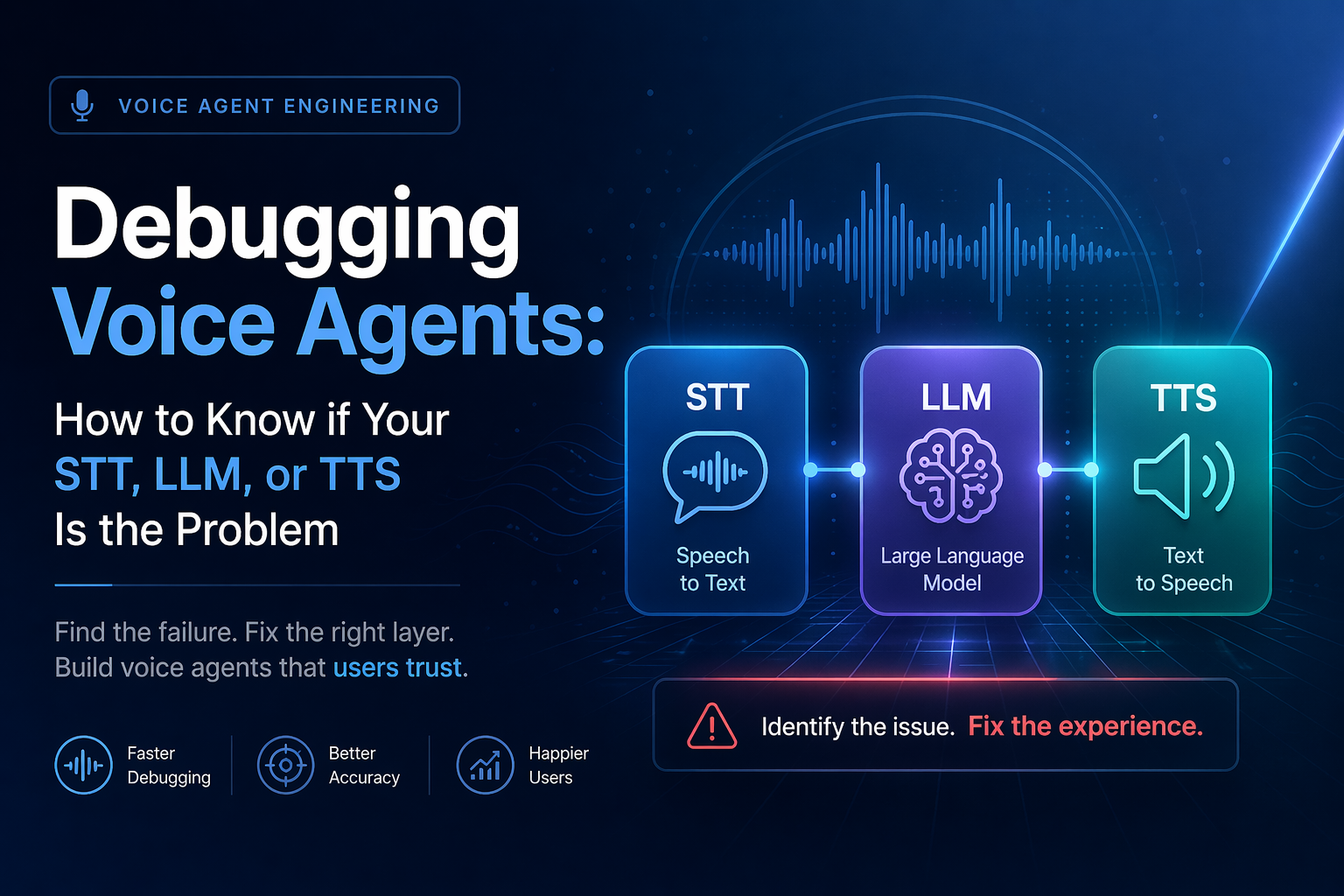
Measure intent and slot accuracy on held-out real calls, not English WER alone. A model that looks strong on English benchmarks may still fail Mumbai barge-in. Guide: Fine-tune for Indic languages. Buyer lens: Best AI Agent for Indic Languages. Voice stack: Debug STT/LLM/TTS.
When Should You Use Synthetic Data?
Short answer: To cover rare intents and privacy-safe variants after you have a real-data seed set—and always validate on held-out real calls.
Synthetic data shines when real traffic is sparse: long-tail intents, adversarial jailbreak variants, multilingual paraphrases, or redacted privacy-safe copies of sensitive fields. It fails when it replaces your real distribution—models learn fluent patterns that never appear in production, and if your eval set is also synthetic, you will not notice until customers do.
Rule of thumb: seed with real failures first (often 100–500 labeled journeys), augment with synthetic at roughly 1:1 to 3:1 synthetic-to-real for gap-filling—not 10:1 replacement. Always keep a real held-out test set that synthetic examples never touch. Guide: Synthetic data for AI agents. Measurement: Benchmark accuracy.
How Do You Reduce Domain Training Time?
Short answer: Prefer adapters/LoRA-style updates, active learning on hard examples, and smaller specialized models for routing.
Full fine-tunes on base models burn GPU weeks and often overwrite general competence. Parameter-efficient adapters (LoRA, IA³, prompt tuning) target the layers that matter for your domain while keeping the base frozen—typical adapter runs finish in hours to a few days vs multi-week full runs. Active learning prioritizes labeling sessions where the model is most uncertain or where ensemble disagreement is highest, so each human hour moves eval needles faster.
Split the stack: a small router for intent/language detection, a stronger model only for complex tool chains, cached embeddings for static policy RAG. Stop training when private evals plateau—more epochs without better labels rarely help containment. Guide: Reduce training time for domain agents. Latency tie-in: Improve agent latency.
Auto-train loop
- Capture production failures (transcripts + tool traces + outcomes)
- Label minimal gold set (prioritize hard / high-impact intents)
- Augment with careful synthetic (gap-fill only, not replace real)
- Train / adapt (adapters first; full fine-tune only if needed)
- Gate on private evals (task success, tools, policy—no regressions)
- Shadow → canary → promote with rollback
What Should an Eval-Gated Training Pipeline Look Like?
Short answer: Frozen test set, weekly failure mining, adapter experiments, and promotion only on metric lift.
- Frozen eval set: 100–500 real journeys covering happy paths, refusals, code-mix, and policy edge cases. Never train on it.
- Failure taxonomy: Tag misses as STT, intent, tool args, hallucination, or policy—fix the highest-volume class first.
- Experiment log: Every adapter run records data version, hyperparams, and eval deltas so you can roll back.
- Shadow compare: New model proposes actions on live traffic before customers see them.
Improvement hub: How to Improve AI Agents. Hallucination control during training: Reduce hallucinations.
Topic Cluster
Also: Improve AI agents · Benchmark accuracy · Best AI Agent India 2026 · Add guardrails