Enterprise AI Agents: High-Impact Use Cases Beyond Customer Support | VAIU AI
Enterprise AI Agents: High-Impact Use Cases Beyond Customer Support
Chatbots learned to talk years ago. What's actually changing the economics of the enterprise is something quieter: AI that closes the loop, inside the systems that already run the business.
It's Monday, 9:04 a.m.
A hospital's front desk has three lines blinking and one receptionist. A citizen has been on hold with a municipal helpline long enough to consider just driving down in person. A finance team is three days into what should have been a same-day follow-up on forty overdue invoices. Somewhere in a call center, an agent explains, for the fourth time before lunch, how to reset a password.
None of this is a crisis. It's just Monday. It repeats on Tuesday, and the Monday after that, inside organizations that have modernized almost everything else, their software, their supply chains, their dashboards, except the conversation happening at the front door.
What if these conversations never needed to wait for a human?
The Shift
For most of the last decade, "AI" inside an enterprise meant a chatbot bolted onto a website. It answered FAQs, deflected a share of support tickets, and mostly lived inside a widget nobody outside the support team ever thought about. That was Conversational AI's first act, and it was useful, in a narrow way.
It was never going to change how an organization runs, though, because answering a question and resolving a request are two different jobs. A chatbot that tells a patient the clinic's hours has automated a sentence. It hasn't booked the appointment, updated the record, or sent the confirmation.
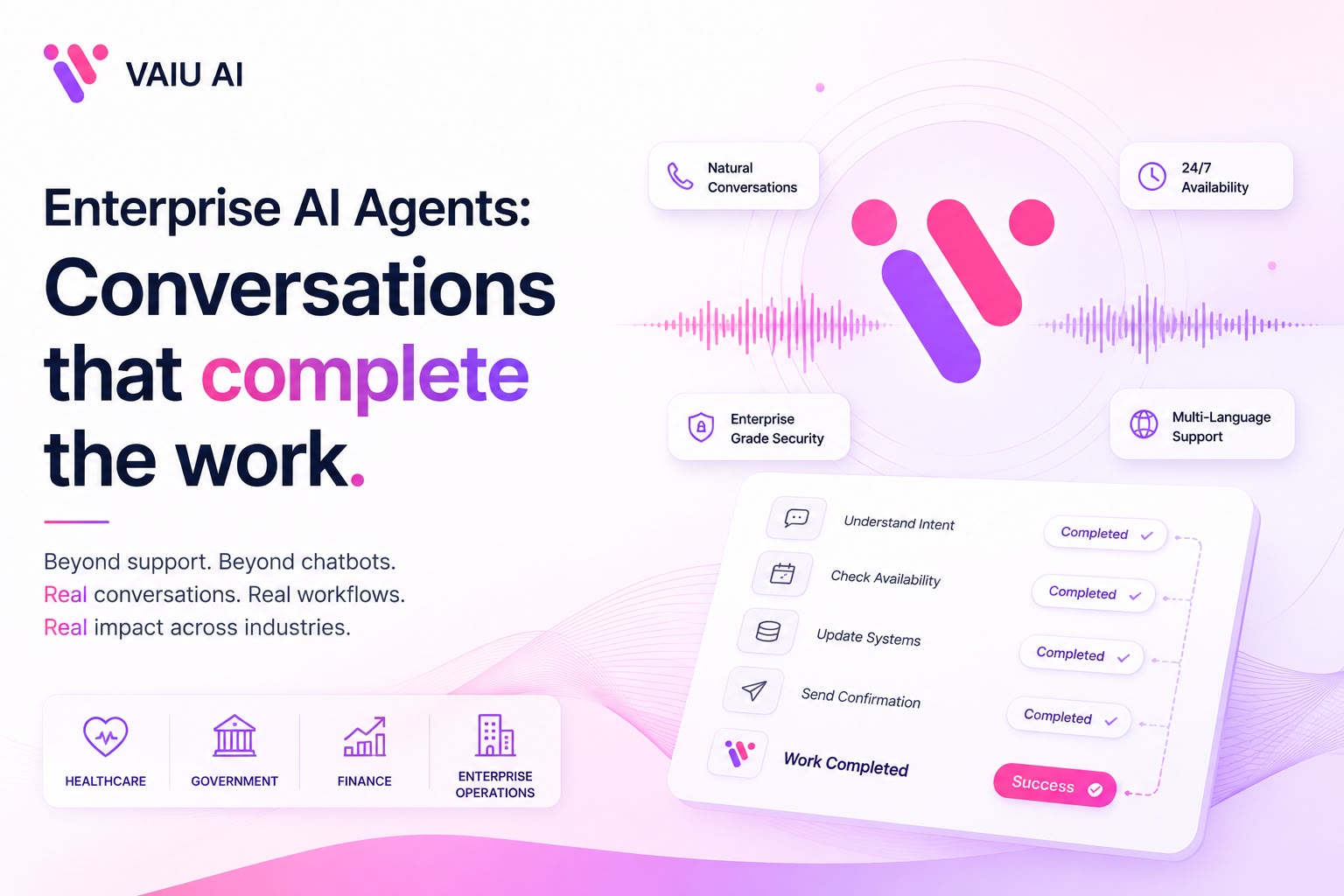
That distinction sounds small. It isn't. It's the entire gap between a tool that talks and a tool that works, and it's the idea now reshaping how healthcare systems, government agencies and finance teams think about Enterprise AI. Enterprise AI Agents are built around that gap. They don't just respond, they reason through a request, connect into the systems already running the business, a scheduling platform, a case management tool, a CRM, and carry the interaction through to a completed outcome.
An agent that answers a question has automated a conversation. An agent that reschedules the appointment, updates the record and confirms it by text has automated a job.
Show, Don't List
The clearest way to see this shift isn't a feature list. It's watching the same request run down two different paths.
The Gap
Not all of this is equally mature, and it's worth saying plainly, because thought leadership that pretends otherwise isn't useful to anyone actually evaluating a vendor.
A lot of Enterprise AI sounds impressive in a fifteen-minute demo and comes apart in week three of production. The tells are consistent. Agents that sound robotic instead of conversational. Agents that lose the thread the moment a caller interrupts or changes topic mid-sentence. Agents that can answer a question but can't act inside the system where the actual work lives, because they were never wired into it. Some run on scripted decision trees dressed up as intelligence, which holds up fine for the scenario shown in the demo and struggles the moment a real caller has a real, messy version of that same conversation.
The pattern behind most of these failures isn't a model quality problem. It's an integration and context problem. An agent that can't retain what was said two minutes ago, and can't reach into the calendar, the case system or the CRM it needs to actually finish the task, was never going to survive contact with a real caller, no matter how natural its voice sounds.
What Building This Actually Taught Us
Building VAIU AI taught us something about where that gap really lives.
The hard part was never making an AI Employee sound natural on a call. Voice quality solved itself faster than most people expected. The hard part was making that same AI Employee reliably finish the work behind the call: verifying who it's actually talking to, reaching into the right system of record, and handing off cleanly the moment a request falls outside its scope.
That's the philosophy VAIU AI is built around. Not a chatbot layered on top of a business, an AI Employee that reasons through a request, retains context across a conversation and across sessions, works inside the systems a hospital, a government office or a finance team already runs on, and knows precisely when to bring a person in.
This isn't only a healthcare story. The same underlying architecture handles a patient rescheduling a scan, a citizen requesting a utility record and a finance team following up on an overdue invoice, because the core job, understand the request, verify identity, complete the task inside the right system, hand off when needed, doesn't change much across industries. What changes is the system on the other end, and the language the conversation needs to run in. VAIU's agents operate in over a dozen languages, which matters more in government and healthcare than almost anywhere else, and can run on-premise or in a private cloud for institutions that can't let sensitive data leave their own infrastructure.
One Conversation, Several Systems
Here's what that looks like end to end.
"I need a copy of my property tax receipt."
What the caller experiences is one relaxed, two-minute conversation. What happens behind it is a short, invisible sequence:
None of that sequence is visible to the caller. That's the point. Several enterprise systems just worked together in the time it takes to order a coffee, and the person on the other end of the call experienced none of the coordination, only the outcome.
People remember conversations. Businesses remember completed workflows.
Government agencies and utilities that have deployed this kind of workflow have seen a typical citizen service call drop from around seven minutes to closer to two, simply because the agent is querying the record instead of routing the caller toward someone who can.
What Actually Changes
It's a fair question whether any of this is meaningfully different from a well-built chatbot. In practice, the difference shows up in a handful of specific places.
| Capability | Conversational Chatbot | Enterprise AI Agent |
|---|---|---|
| Primary job | Answers questions | Completes the workflow behind the question |
| Memory | Resets each session | Retains context across a call and across sessions |
| System access | Reads a knowledge base | Reads and writes to CRMs, EHRs and case systems |
| When it's stuck | Loops or deflects | Hands off to a person with full context intact |
| Deployment | Cloud-only, one-size-fits-all | Cloud, VPC or on-premise, for regulated data |
The Work That Quietly Disappears
The future of Enterprise AI won't be defined by how convincingly it sounds human on a call. Voice quality is close to solved industry-wide, and within a few years it will stop being a differentiator at all.
What will matter is something less visible: how much work quietly disappears from a team's day without anyone having to notice it happened. Not a faster chatbot. Fewer things left undone.
The organizations already running this today, inside hospitals, government offices and finance teams, didn't start with a sweeping transformation plan. They started with one well-scoped conversation that used to eat an afternoon, and let it run itself. That's usually where the real advantage begins, not in the ambition of the rollout, but in the discipline of where it starts.