Emotion-Aware Voice Agents: How AI Now Detects Frustration and Adjusts in Real Time
I have spent years watching voice AI hear every word a customer said and miss everything they actually meant. That gap between transcript and truth is finally closing, and what is replacing it is more interesting than most people realise.
There is a phrase that anyone who has spent time in customer operations knows intimately: "fine, whatever." said in a tone that makes the hair on the back of your neck stand up. It does not mean fine. It means the customer has already decided to leave. For most of the past decade, voice AI heard those words, logged them as neutral sentiment, and moved on. Completely blind to the emotional freight they carried.
Market Value 2024
Annual Growth
Model Accuracy
What the Machine Is Actually Listening For
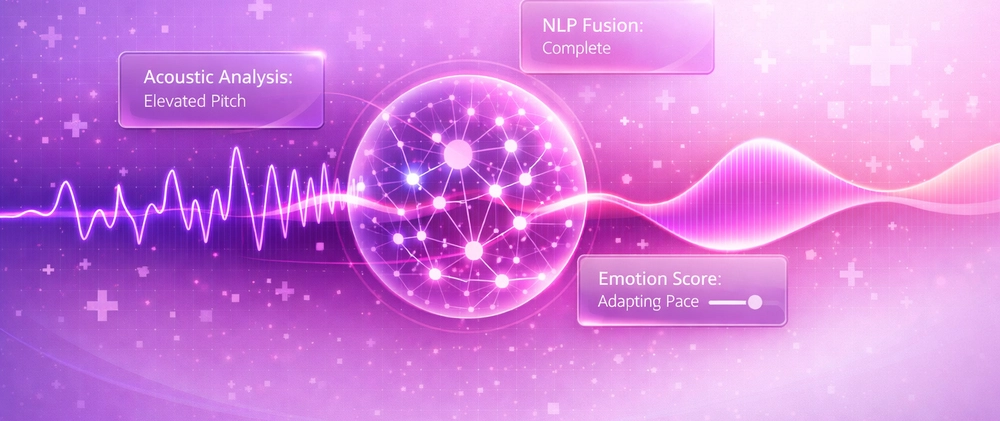
A voice agent doing real-time emotion analysis runs parallel analysis across several signal streams at once. Prosodic features like pitch, tempo, rhythm, and pauses are the acoustic fingerprints of emotional state.
Frustration typically produces shorter inter-phrase pauses, rising pitch toward the end of utterances, and an increased speech rate. Modern models have learned these patterns well enough that the signal is reliable even when the words are deliberately calm.
"A slight tremor in a caller's voice, even when their tone sounds calm, can indicate hidden anxiety. This deeper understanding is what separates a reactive system from a genuinely intelligent one."
Where Vaiu Is Taking This Further
Most emotion-aware voice agents are built for contact centers, optimised for churn reduction and ticket deflection. At Vaiu, we made a different call: that the highest-stakes emotional interactions are happening in healthcare.
🏥 Spotlight: Vaiu AI
Emotionally Intelligent AI Medical Staff, Purpose-Built for Clinics
In healthcare, a missed emotional signal might mean a patient who does not come back or a medication schedule that quietly gets abandoned. Our agents pick up on signals of anxiety or distress and adjust responses accordingly in the moment.
When patients feel heard rather than processed, the downstream metrics follow.