Before and After: What a Clinic's Phone Operations Look Like 90 Days After Deploying Voice AI
Most clinics do not realize how much their phone line is costing them until they look at the numbers. Missed calls during lunch hour. Patients placed on hold for four minutes just to confirm a follow-up. Front-desk staff spending their morning booking appointments rather than supporting patients in the waiting room. This is the story of what changes when a mid-size outpatient clinic deploys Vaiu's Voice AI platform and then, three months later, looks back at what was there before.
The Starting Point
The clinic in question operates across two locations with a combined volume of roughly 340 patient calls per day. A team of five front-desk staff handles appointment scheduling, prescription routing, insurance pre-authorization queries, and general patient inquiries. Before deployment, the clinic was functioning. Not failing, but carrying a quiet operational drag that was hard to quantify until someone started measuring it.
A two-week pre-deployment audit surfaced the following baseline numbers:
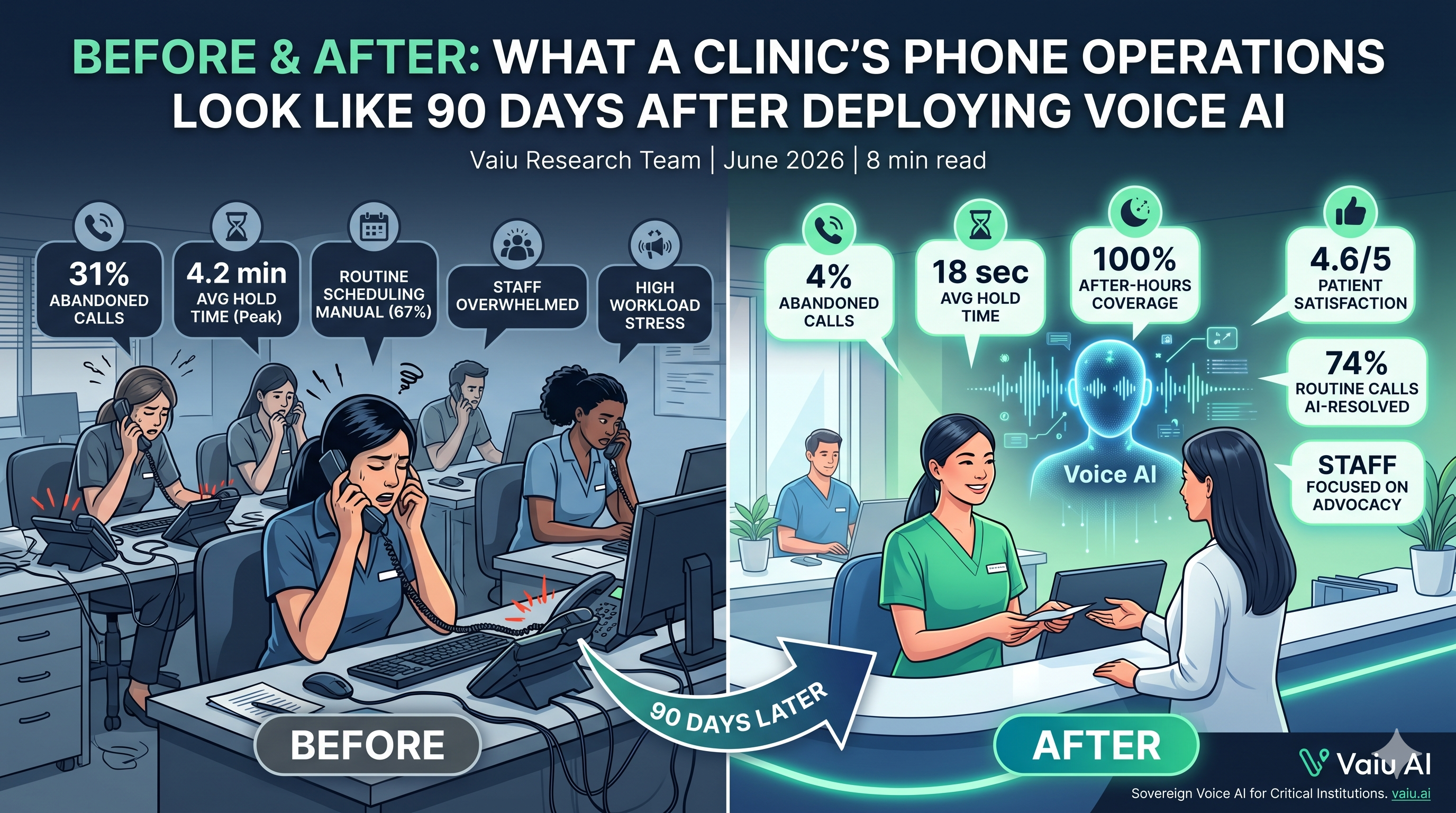
of inbound calls abandoned before reaching staff
average hold time during peak morning hours
of calls were routine scheduling handled manually
The clinic manager described the front desk as running on "organized stress." Staff were competent and experienced, but the call volume was eating into every other task. Documentation fell behind. Patient intake slowed. When a staff member was absent, the entire phone operation noticeably buckled.
What Deployment Actually Looked Like
Vaiu's implementation team ran a structured onboarding over 12 days. The clinic did not shut down its front desk. There was no rip-and-replace moment. The process was additive: Vaiu's voice agents came online as a parallel channel, trained on the clinic's own scheduling workflows, insurance protocols, and FAQs. The domain-specific fine-tuning is one of the core differentiators that Vaiu brings to healthcare deployments, where generic language model behavior is not acceptable.
The voice agents were configured to operate in the clinic's two primary languages, with routing protocols that escalated any emotionally distressed caller or medically urgent query directly to a human within seconds. Vaiu's real-time emotion detection continuously monitored each call and flagged signals including frustration, confusion, or distress, feeding that context to staff before they picked up the transfer.
"We told our staff it was there to handle the routine calls so they could focus on the patients actually standing in front of them. Within two weeks, that's exactly what was happening."
— Clinic Operations Manager
The deployment ran on Vaiu's sovereign infrastructure with on-premise data residency, meaning no patient call data left the clinic's controlled environment. All interactions remained fully compliant with HIPAA protocols from day one.
Day 30: First Signals
The first month was observational. The clinic tracked volume, resolution rates, and staff feedback in parallel. Several patterns emerged quickly:
Week 1: Abandoned call rate drops immediately
The most visible change was in abandoned calls. Because Vaiu's agents answered within two rings regardless of simultaneous call volume, patients who previously hung up after being placed on hold were now reaching a voice that could actually help them. By the end of week one, the abandoned call rate had fallen from 31% to 9%.
Week 2: Staff reallocate the first 90 minutes of each day
Monday mornings, historically the clinic's most congested window, became noticeably quieter at the front desk. Staff who normally spent 8:30 to 10:00 AM working through a backlog of voicemails and booking requests were freed to focus on patient intake and room preparation. The shift was unplanned but consistent.
Week 3-4: Scheduling accuracy improves
Manual double-bookings had been a recurring issue, occurring roughly twice per week across both locations. Vaiu's agents worked directly against the clinic's appointment system in real time, eliminating the human transcription step that had been generating errors. By the end of month one, double-bookings had dropped to zero.
Day 60: The Staff Question
The most common anxiety going into any Voice AI deployment is about what happens to existing staff. At the 60-day mark, the clinic's experience was straightforward: no one was let go. The front desk team of five remained intact. What changed was the nature of their work.
Staff reported spending less time on hold management and scheduling confirmation calls. They reported spending more time on tasks requiring human judgment: translating instructions for elderly patients, managing complex insurance exceptions, supporting patients presenting with acute distress. One staff member described the shift as moving from being a "call center" to being actual patient advocates.
Emotional Intelligence as Infrastructure
Vaiu's platform continuously analyzes vocal patterns for emotional indicators including anxiety, confusion, and urgency. When a caller's emotional state crosses a defined threshold, the system escalates to a human agent in real time, with a summary of the call context already prepared. Staff at this clinic described receiving warm transfers where they already knew what the patient needed before saying hello.
Multilingual Capability Without Extra Headcount
The clinic serves a multilingual patient population across its two locations. Before deployment, non-English-speaking callers often had to wait for a specific staff member or call back at a different time. Vaiu handles over 12 languages natively, meaning every caller receives the same quality of service regardless of language, time of day, or staffing levels.
Day 90: The Full Picture
At the three-month mark, the clinic ran a structured retrospective comparing its post-deployment metrics against the pre-deployment baseline. The results were consolidated across both locations and covered inbound volume, resolution rates, patient satisfaction scores, and staff workload distribution.
| Metric | Before Vaiu | After 90 Days | Change |
|---|---|---|---|
| Abandoned call rate | 31% | 4% | -87% |
| Average hold time (peak hours) | 4.2 minutes | 18 seconds | -93% |
| Routine calls resolved without staff | 0% | 74% | +74 pts |
| Scheduling errors (per week) | 2.1 avg | 0 | Eliminated |
| Calls answered outside business hours | 0 | 100% | Full coverage |
| Patient satisfaction (phone experience) | 3.1 / 5 | 4.6 / 5 | +48% |
| Staff-reported workload stress | High | Low to moderate | Significant shift |
The numbers tell one part of the story. The other part is harder to quantify: the front desk started feeling like a different place to work. Staff who had been burning out on call volume were now handling the interactions where their presence actually mattered. The phone system stopped being a source of daily friction and started behaving like infrastructure that simply worked.
What the Before/After Looks Like Side by Side
To make the operational contrast concrete, here is how a typical Monday morning compared across the two periods:
Before Vaiu
- 8:30 AM
Staff arrive to 14 unheard voicemails. First 45 minutes spent returning calls and logging appointment requests manually. - 9:00 to 11:00 AM
Peak inbound volume. Two staff members dedicated entirely to answering phones. Patients in the waiting room receive delayed attention. - Lunch hour
Reduced staffing means calls go unanswered or to voicemail. Patients who call during lunch often call back in the afternoon, creating a second spike. - After 5:00 PM
Phones go to a generic voicemail. Urgent non-emergency queries wait until the next morning. Some patients call multiple times trying to reach someone.
After 90 Days with Vaiu
- 8:30 AM
Staff arrive to a structured handover summary from Vaiu's overnight agents. 3 calls flagged for follow-up, already categorized by priority. - 9:00 to 11:00 AM
Vaiu handles 70%+ of inbound calls autonomously. Staff assist patients in-person without interruption. Complex calls escalate with full context already prepared. - Lunch hour
Vaiu operates at full capacity regardless of staffing. No patient waits, no calls drop to voicemail, no afternoon callback surge. - After 5:00 PM
Vaiu continues handling scheduling, FAQs, and medication refill routing. True emergencies are redirected to appropriate services. No patient is left without a response.
What This Means for Clinic Operations Going Forward
The 90-day window is significant not because the results plateau there, but because it is the point at which the new operational baseline becomes the new normal. Vaiu's platform continues to learn from clinic-specific interactions over time. The longer it runs, the more accurately it handles edge cases, seasonal volume spikes, and the nuanced language of that particular patient population.
For the clinic's leadership team, the 90-day data made one thing clear: the phone line had always been a clinical touchpoint, not just an administrative one. How a patient feels during their first call shapes how they experience the entire practice. Getting that interaction right from the start is not a back-office problem. It is a care quality problem.
Vaiu's Voice AI platform is built for exactly this reality. It is not a chatbot bolted onto a scheduling portal. It is a sovereign, HIPAA-compliant, emotionally intelligent voice infrastructure designed for institutions where the cost of a bad interaction is not just a missed booking but a patient relationship that does not continue.
"The clinics getting the most from Voice AI in year one are not the ones that tried to automate everything. They are the ones that identified the calls their staff should not have to take, and gave those to Vaiu, so their people could focus on the calls that only a person can handle well."
— Vaiu Healthcare Deployment Team
Is Your Clinic Three Months Away From This?
The deployment timeline described here is not exceptional. It reflects Vaiu's standard onboarding structure for mid-size outpatient practices. Clinics with 200 to 600 daily inbound calls are the most common deployment context, and the pattern of results tends to follow a recognizable arc: abandoned call reduction in week one, staff reallocation emerging in weeks two and three, and compounding quality improvements through the end of the first quarter.
The question worth asking is not whether your clinic could see similar results. The more useful question is: what is the current cost of not looking into it? Every abandoned call is a patient who called a competitor's number next. Every scheduling error is a gap in care continuity. Every staff member burning out on routine call volume is a retention risk you may not be measuring yet.
Vaiu is deployed across healthcare institutions in the USA, India, Switzerland, the UAE, and Africa. The platform operates natively in 12+ languages and supports on-premise, VPC, and hybrid cloud deployments for institutions that require total data sovereignty.