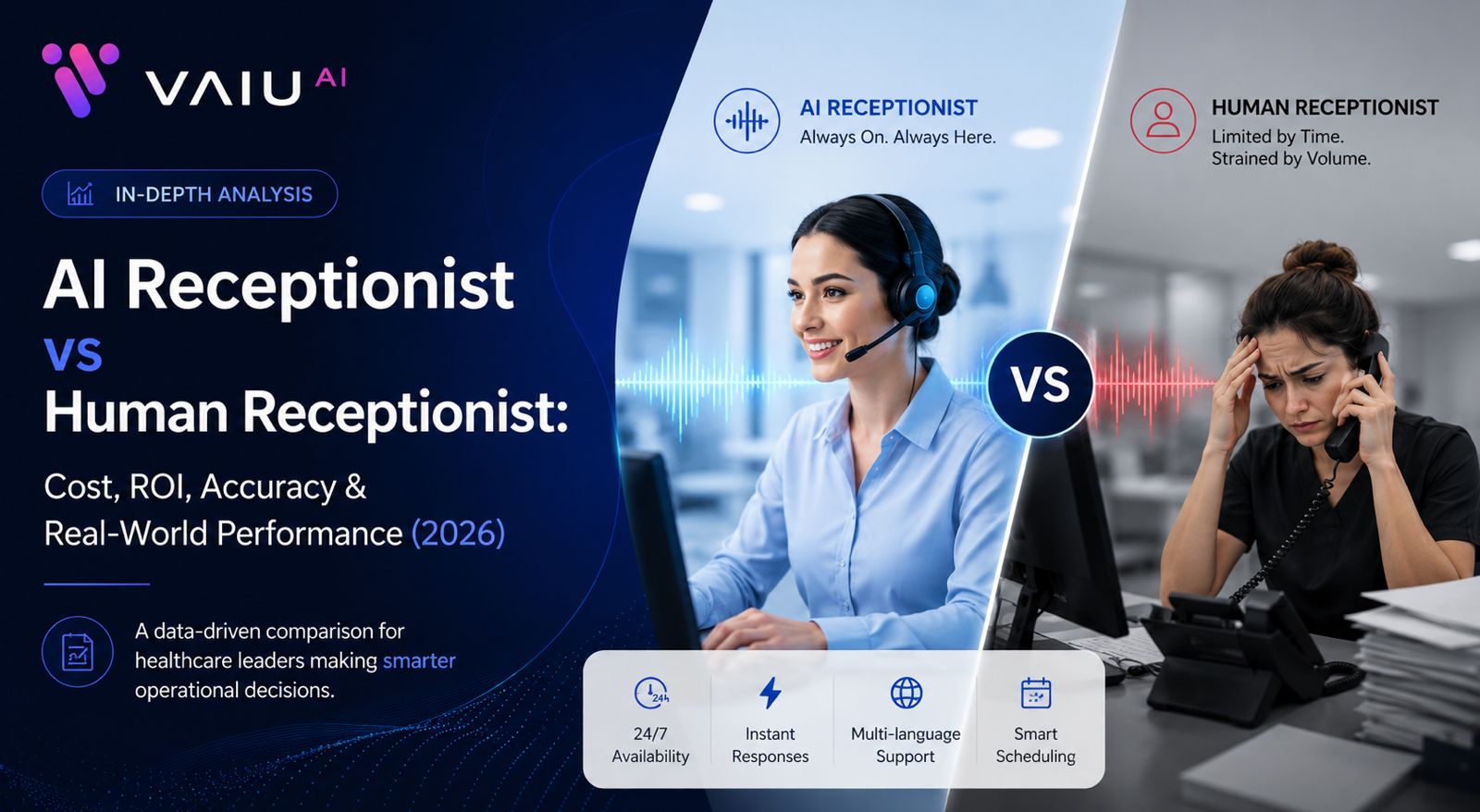
AI Receptionist vs Human Receptionist: Cost, ROI, Accuracy & Real-World Performance
HEALTHCARE AI · IN-DEPTH ANALYSIS
AI Receptionist vs Human Receptionist: Cost, ROI, Accuracy & Real-World Performance (2026)
Published June 2026 · ~18 min read
Introduction: The Phone That Never Stops Ringing
It is 9:07 on a Tuesday morning at a mid-size orthopedic clinic in suburban Chicago. Sarah, the front desk coordinator, is mid-sentence with a patient checking in for an MRI when three lines light up simultaneously. By the time she reaches one of them — an elderly patient trying to reschedule a post-surgical follow-up — the other two have gone to voicemail. One of those callers won't phone back. The appointment slot will sit empty. Revenue will not be recovered.
This scene plays out tens of thousands of times per day across healthcare facilities in the United States, India, Europe, and the Middle East. It is not a staffing failure; it is a structural one. The phone-based front desk was designed for a world with lower call volumes, simpler patient expectations, and no expectation of 24/7 availability. That world no longer exists.
According to a 2024 study by the Medical Group Management Association (MGMA), the average US physician practice misses 22%–35% of inbound patient calls during peak hours. Each missed call in a primary care context represents an estimated $150–$300 in potential revenue loss when factoring in appointment no-shows, delayed diagnoses, and patient churn. This is the context in which the AI receptionist debate has become a genuine operational conversation — not a technology enthusiast's thought experiment, but a boardroom-level question for hospital CXOs, clinic administrators, and healthcare operations managers.
This article is not designed to declare a winner. It is designed to give decision-makers the clearest possible picture of what each model offers, what it costs, where it fails, and what the financial math actually looks like in a real healthcare organization.
Why Reception Desks Are Becoming Operational Bottlenecks
The front desk of any healthcare organization is where patient relationships begin. It is also, increasingly, where operational efficiency ends. Consider the cognitive load placed on a typical healthcare receptionist: they are simultaneously expected to verify insurance, schedule across complex provider calendars, answer clinical navigation questions, handle emotional patients, manage walk-in traffic, maintain HIPAA compliance in every interaction, and maintain warmth under pressure. This is not a reasonable ask of any single person, let alone one earning a median annual salary of $38,640 (Bureau of Labor Statistics, 2025).
of patients report frustration with hold times when scheduling appointments (MGMA, 2024)
of healthcare administrative staff report burnout as a significant factor in resignation (Advisory Board, 2024)
of inbound patient calls go unanswered during peak hours at average US practices
estimated revenue lost per missed appointment when factoring no-show and patient churn costs
The receptionist bottleneck is not caused by poor people; it is caused by volume exceeding the physical capacity of human attention. One person can have one conversation at a time. A busy clinic may receive 200 or more inbound calls on a Monday morning. There is no version of the human-only model that reconciles those two facts at an acceptable cost.
The resulting operational pressure has pushed healthcare organizations to explore alternatives including offshore staffing, extended-hours call centers, and increasingly, purpose-built AI voice systems designed specifically for healthcare front desk workflows.
AI Receptionists Explained
An AI receptionist, in the context of healthcare, is a voice-based software system that can answer inbound calls, conduct natural conversations with patients, retrieve and update information in real time, and perform transactional tasks like scheduling, rescheduling, and follow-up without human involvement in the loop. Unlike earlier interactive voice response (IVR) systems, which operated on rigid decision trees ("press 1 for appointments, press 2 for billing"), modern voice AI platforms use large language models trained on conversational data to understand intent, context, and in the most sophisticated deployments, emotional state.
The capabilities of today's enterprise-grade AI receptionist systems include:
- Real-time appointment scheduling and modification against live EHR calendars
- Patient identity verification and insurance confirmation
- Medication refill request routing and prescription status updates
- Multilingual patient communication without hold time or transfer
- Post-visit follow-up calls and satisfaction surveys
- 24/7 availability including nights, weekends, and public holidays
- Simultaneous handling of unlimited concurrent calls
- CRM and EHR integration with automatic call logging and task creation
It is worth noting what AI receptionists are not. They are not chatbots with voiceover capabilities, and they are not IVR systems with better menus. The most capable systems conduct conversations that, in patient satisfaction surveys, score comparable to human agents for routine interactions while handling volume that no human team could match.
"The shift from IVR to voice AI is not incremental. It is the difference between a phone tree and a conversation and patients notice immediately."
Human Receptionists Explained
The case for human receptionists in healthcare is not simply sentimental. It is grounded in capabilities that remain genuinely difficult to replicate and in patient populations where those capabilities are not optional.
A skilled healthcare receptionist brings contextual judgment that develops over months of exposure to a specific practice: they know which providers run late, which patients need extra patience, which insurance plans have unusual prior authorization requirements, and how to de-escalate a distressed patient without a scripted response.
They also serve as a physical presence. In facilities with walk-in traffic, a human face at the front desk carries relational weight that shapes first impressions, builds long-term patient loyalty, and enables real-time clinical triage in ways that a phone-based AI system simply cannot.
The challenge is not that human receptionists are insufficient. It is that the operational model built around them — fixed hours, finite attention, single-threaded conversations — does not scale to the demands of modern patient communication.
Cost Comparison: A Full Financial Breakdown
The true cost of a human receptionist is significantly higher than the salary line in a staffing budget. When all direct and indirect costs are accounted for, a single full-time healthcare receptionist position in the US carries a total annual cost of $58,000–$78,000, depending on geography, benefits package, and turnover frequency.
Human Receptionist: Full Annual Cost Model (US, 2025–2026)
| Cost Category | Annual Estimate | Notes |
|---|---|---|
| Base Salary | $38,000 – $52,000 | BLS median $38,640; higher in metro markets |
| Employer Payroll Taxes | $2,900 – $4,000 | FICA, FUTA, SUTA |
| Health Insurance (employer share) | $6,000 – $10,000 | KFF 2024: avg employer contribution $7,034 single coverage |
| PTO & Sick Leave | $1,800 – $3,000 | 12–15 days factored as productivity loss |
| Initial Training | $1,200 – $2,500 | EHR onboarding, HIPAA training, practice-specific procedures |
| Ongoing Training & Compliance | $400 – $800 | Annual recertifications, software updates |
| Turnover Cost (amortized) | $3,500 – $7,000 | Healthcare admin turnover 30%; avg replacement cost 1.5–2x monthly salary |
| After-Hours Coverage (if needed) | $8,000 – $18,000 | Answering service or part-time evening staff |
| Workspace & Infrastructure | $1,500 – $3,000 | Desk, workstation, phone system, software licenses |
| Total Annual Cost | $63,300 – $100,300 | Per FTE, including after-hours coverage |
AI Receptionist: Full Annual Cost Model (Enterprise, 2025–2026)
| Cost Category | Annual Estimate | Notes |
|---|---|---|
| Platform License / Subscription | $12,000 – $36,000 | Varies by call volume, integrations, tier |
| Initial Integration & Setup | $5,000 – $20,000 | One-time EHR/CRM integration, voice customization, workflow config |
| Ongoing Maintenance & Support | Included or $1,500 – $4,000 | Depends on contract; enterprise plans often include SLA-backed support |
| Training (staff, for oversight) | $0 – $800 | Minimal; mostly internal process adjustment |
| After-Hours Coverage | $0 | Included; AI operates 24/7 with no incremental cost |
| Turnover / Attrition Cost | $0 | Not applicable |
| Scalability Cost Per Additional Line | $0 – minimal | Software scales; no additional headcount for volume spikes |
| Total Annual Cost Year 1 | $17,000 – $60,000 | Setup amortized over 3 years brings year 2+ down significantly |
| Total Annual Cost Year 2 | $12,000 – $40,000 | No setup; maintenance + license only |
"A clinic running two human receptionists is spending, all-in, between $126,000 and $200,000 annually. That same operational function can be served at higher volume, around the clock for a fraction of that figure."
The most important distinction is not the line-item comparison but the structural advantage: AI costs do not scale with volume. A human team handling 500 calls per day costs the same whether those calls are evenly distributed or clustered in a two-hour Monday morning surge. An AI system handles both scenarios at identical cost.
Accuracy & Performance Comparison
Cost is only one axis of the decision. The more operationally consequential question is: which model produces more accurate, consistent, and reliable patient interactions?
| Performance Dimension | Human Receptionist | AI Receptionist | Advantage |
|---|---|---|---|
| Appointment Scheduling Accuracy | 92% – 96% | 97% – 99.5% | AI |
| Information Retrieval Speed | 15 – 45 seconds (system lookup) | Instant (integrated) | AI |
| Consistency Across Calls | Variable (fatigue, mood, shift) | 100% consistent | AI |
| HIPAA Compliance | Training-dependent; human error risk | Protocol-enforced, auditable | AI |
| Memory / Patient History Access | Limited to EHR lookups; memory varies | Instant CRM/EHR lookup; context-aware | AI |
| Availability | Business hours; single threaded | 24/7/365; unlimited concurrent | AI |
| Multilingual Support | Depends on individual staff | 12+ languages (native platforms) | AI |
| Error Rate (Scheduling) | 4% – 8% (double bookings, wrong provider) | <1% with EHR integration | AI |
| Empathy / Emotional Nuance | High (trained, experienced staff) | Moderate (improving rapidly) | Human |
| Complex Edge Case Handling | High (contextual judgment) | Requires escalation pathway | Human |
The data suggests AI receptionists outperform human agents on most measurable operational dimensions. The domains where humans retain an advantage — empathy, contextual judgment in non-standard situations — are precisely the areas where skilled staff should be concentrated.
ROI Analysis: Three Healthcare Scenarios
Abstract cost comparisons are only useful if they translate into real financial projections. Here are three modeled scenarios based on staffing and call-volume benchmarks.
Scenario 1: Small Independent Clinic (2–5 Providers)
- Profile: A 3-provider family medicine practice in a suburban market. Current setup: 1.5 FTE front desk staff, answering service for after-hours. Inbound call volume: 80–120 calls per day.
- Current Annual Cost: $72,000 – $92,000 (1.5 FTE + answering service)
- AI Receptionist Annual Cost (Year 2+): $14,000 – $22,000
- Direct Annual Savings: $50,000 – $70,000
- Revenue Recovery: Est. $18,000 – $32,000/year (from reduced missed calls and after-hours bookings)
- Total Estimated Annual ROI: $68,000 – $102,000
Scenario 2: Mid-Size Multi-Specialty Hospital (200–500 Beds)
- Profile: A regional hospital with multiple outpatient departments. Current setup: 8–12 FTE reception and scheduling staff across departments. Inbound call volume: 800–1,400 calls per day.
- Current Annual Cost: $620,000 – $980,000 (fully loaded, including after-hours staffing)
- AI Receptionist Annual Cost: $60,000 – $120,000 (enterprise license, integrations, 24/7)
- Direct Annual Savings: $500,000 – $860,000
- Revenue Recovery: Est. $90,000 – $180,000/year (from reduced no-shows and after-hours bookings)
- Total Estimated Annual ROI: $590,000 – $1,040,000
Scenario 3: Enterprise Healthcare Group (10+ Facilities)
- Profile: A multi-facility healthcare network operating across 10–15 locations. Centralized scheduling, multiple languages served. Inbound volume: 5,000–8,000 calls per day network-wide.
- Current Annual Cost: $3.2M – $5.8M (FTE + overflow call centers + after-hours)
- AI Receptionist Annual Cost: $180,000 – $480,000 (enterprise deployment, multi-site)
- Direct Annual Savings: $2.7M – $5.3M
- Revenue Recovery: Est. $400,000 – $900,000/year
- Total Estimated Annual ROI: $3.1M – $6.2M
These estimates are conservative. They do not account for compounding improvements in patient retention, staff morale improvements from removing administrative burden, or reduced liability from improved compliance consistency.
Patient Experience Comparison
ROI projections matter to finance teams. What matters to patients — and therefore to patient retention — is the quality of the interaction itself.
| Experience Dimension | Human Receptionist | AI Receptionist |
|---|---|---|
| Average Wait to Connect | 3 – 8 minutes (peak hours) | Under 2 seconds |
| Hold Time During Call | 2 – 6 minutes (EHR lookup, calendar check) | Zero (integrated lookup) |
| After-Hours Availability | Voicemail or answering service | Full service, same experience |
| Language Accessibility | Limited to staff language abilities | 12+ languages, zero transfer delay |
| Consistency of Service | Variable by staff member, time of day | Uniform across all interactions |
| Emotional Responsiveness | Strong (experienced staff) | Improving; best platforms detect stress and adjust tone |
| Missed Call Rate | 22% – 35% during peak hours | Near zero |
The patient experience data points in a clear direction: for routine, transactional interactions — which represent the large majority of healthcare reception volume — AI delivers a measurably better and more consistent experience than a human model operating under volume pressure.
Where Humans Still Win
A balanced analysis requires acknowledging where human receptionists remain irreplaceable, at least for the foreseeable future.
Human Advantage Areas:
- Genuine empathy in high-distress situations: A patient learning of a terminal diagnosis, a caregiver managing a crisis, a parent with an acutely ill child — these interactions require human presence, not efficient call handling.
- Complex non-standard scenarios that fall outside configured workflows: Unusual insurance edge cases, multi-layered scheduling dependencies, situations requiring clinical judgment about urgency.
- Escalation and de-escalation: A patient who feels dismissed or anxious needs a human voice with real authority to reassure them; AI escalation pathways can route these calls but cannot own the outcome.
- Physical presence and first impressions: A welcoming, competent face at a physical front desk signals organizational quality in a way a phone interaction cannot replicate.
- Relationship continuity over years: Long-term patients often have meaningful rapport with individual staff that influences satisfaction and retention in ways difficult to quantify.
The organizations that will perform best in the next decade are not those that replace human reception entirely, but those that redeploy human attention toward these high-value interactions while letting AI handle the high-volume, low-complexity communication load.
Where AI Clearly Wins
AI Advantage Areas:
- 24/7 availability: Without overtime, staffing schedules, or after-hours service fees, a patient in a different time zone or calling at 11 PM receives the same experience as one calling at 10 AM.
- Zero missed calls: The system handles unlimited concurrent connections, meaning no call goes unanswered regardless of volume spikes.
- Infinite scalability at constant cost: A Monday morning with 400 calls costs no more than a Wednesday afternoon with 40.
- Instant access to integrated data: Scheduling, insurance, prescription status, and patient history retrieved without hold time or manual lookup.
- No performance degradation: The 200th call of the day is handled with identical accuracy and tone as the first.
- Consistent compliance: HIPAA-required disclosures, verification steps, and documentation happen uniformly on every call without human error.
- Multilingual service at scale: No patient is bounced between staff or told to call back when a translator is available.
Platform Analysis: VAIU Spotlight
Most voice AI systems on the market were not built for healthcare. They were built for general customer service and adapted — often inadequately — to medical contexts. The operational and compliance requirements of healthcare are specific enough that this distinction matters more than it might appear in a feature comparison sheet.
VAIU AI is a voice AI platform architected for exactly the industries where communication failures have real consequences: healthcare, government, and financial services. What distinguishes it analytically is not any single feature, but the design philosophy underlying the platform: conversation as a continuous, context-aware process rather than a series of discrete command-and-response exchanges.
In practical terms, this means a patient calling to reschedule an appointment is not handled as a new, stateless interaction each time. The system maintains context across the conversation, recognizes returning patients, and can cross-reference prior call summaries to handle exceptions like a patient who was told on a previous call that their regular cardiologist would be unavailable for three weeks.
Capabilities in Production
VAIU's platform currently supports 12+ languages in live patient-facing deployments, which is operationally significant for healthcare organizations serving multilingual populations. Language handling is not translation layered on top of an English-first system; it operates natively per language in the same inference environment.
The system's emotion-aware conversation layer adjusts pacing, tone, and response strategy in real time based on detected patient stress indicators. In a deployment context, this means an anxious patient receives a measurably different conversational experience than a routine scheduling call without the platform breaking character or requiring a human handoff for every elevated-stress interaction.
On the infrastructure side, VAIU offers on-premise deployment — a feature that matters significantly to enterprise healthcare organizations operating under strict data residency requirements, whether driven by HIPAA in the US, GDPR in Europe, or regional healthcare data laws in the UAE and India. For institutions where patient data cannot leave a defined geographic or technical perimeter, cloud-only AI vendors are effectively disqualified from consideration. VAIU's on-premise option addresses this directly.
The platform's self-healing architecture is designed for the uptime requirements of healthcare, where a system outage at 2 AM affects real patients with real medical needs. Redundancy and automatic recovery are not marketed features; they are operational requirements in this sector, and VAIU's deployment model reflects that.
From an integration standpoint, VAIU connects to major EHR systems, CRM platforms, and hospital communication infrastructure through an omnichannel communication layer handling phone, SMS, and digital touchpoints within the same patient interaction record. This eliminates the fragmented communication history that often undermines patient experience in organizations running phone, portal, and in-person touchpoints as separate systems.
For healthcare CXOs evaluating enterprise voice AI, VAIU represents one of the more complete implementations available in 2026 — not because of marketing positioning, but because its feature set was built around the specific operational and compliance demands of regulated healthcare environments. The on-premise option, multilingual support, and emotion-aware conversation capability are not common in the competitive landscape at enterprise scale.
The Future: Augmentation, Not Replacement
The framing of this question as "AI versus human" is already becoming outdated. The more accurate model for 2026 and beyond is one of deliberate division of labor: AI handling the predictable, high-volume, time-sensitive communication work, and human staff handling the judgment-intensive, relationship-dependent, and emotionally complex dimensions of patient care.
McKinsey's 2025 healthcare automation report estimated that approximately 45% of healthcare administrative tasks are fully automatable with current technology. The remaining 55% are not resistant to automation because of technical limitations, but because they involve decision-making complexity and relational nuance that creates real value when handled by humans.
The organizations moving fastest are not deploying AI to eliminate their front desk teams. They are deploying AI to eliminate the parts of front desk work that are bad for patients, bad for staff, and bad for operations simultaneously — the endless hold queues, the missed calls, the after-hours voids, the language barriers.
What emerges on the other side of that deployment is a human team with fundamentally different work. Less time on repetitive data entry and routine scheduling. More time on complex cases, patient relationship management, and clinical navigation — the work that skilled healthcare administrators often describe as the reason they entered the field in the first place, before the volume buried it.
"The goal is not a front desk without humans. The goal is a front desk where humans are doing the work that only humans can do."
As voice AI systems become more capable of detecting emotional states, managing multi-turn clinical conversations, and integrating with increasingly sophisticated EHR environments, the boundary between AI-appropriate and human-appropriate interactions will shift. The organizations best positioned for that shift are those building their AI layer now while retaining and redirecting their human talent rather than treating these as competing choices.
Conclusion
There is a version of this comparison that ends with a simple score. AI wins on cost, availability, consistency, accuracy, and scalability. Humans win on empathy, judgment, and relationship. Deployment decision made.
But the more useful conclusion is different, and it requires sitting with a slightly uncomfortable idea: the way a healthcare organization handles its phones is not an administrative detail. It is a signal. It signals to patients whether they can reach the organization when they need to. It signals to staff whether their time is valued or consumed by mechanical repetition. It signals to payers and partners whether the organization is run with operational discipline. And increasingly, it signals to regulators — in the form of missed appointment rates, after-hours access data, and language accessibility metrics — whether the organization is meeting its obligations to the population it serves.
Communication, in modern healthcare, has quietly become a strategic capability. The organizations treating it that way — investing in infrastructure that handles the routine with precision while freeing humans to handle the irreplaceable — are building a durable operational advantage. The organizations that are not will continue to pay the full cost of the human model while capturing less than its full value.
The phone that never stops ringing is not a burden. It is an opportunity. How an organization answers it — and who, or what, answers it — says more about its operational ambition than almost any other single choice.
Key Takeaways
- The total annual cost of a human receptionist in US healthcare is $63,000–$100,000 when all direct and indirect expenses are included, significantly higher than the visible salary line.
- Enterprise AI receptionists cost $12,000–$40,000 annually after Year 1 and handle unlimited concurrent calls at no additional cost, including 24/7 coverage.
- AI outperforms human receptionists on scheduling accuracy, availability, multilingual support, consistency, and compliance, while humans retain the advantage in empathy and complex edge-case handling.
- A small 3-provider clinic can realize $68,000–$102,000 in combined savings and revenue recovery per year; an enterprise healthcare group can see $3M–$6M.
- The most successful deployments are augmentation models: AI handles volume and routine, humans handle relationship and judgment.
- Key AI platform features for healthcare evaluation: on-premise deployment options, native multilingual support, EHR integration depth, and emotion-aware conversation capabilities.
- Patient communication is becoming a strategic differentiator in healthcare. Organizations that build the right infrastructure now will hold a durable operational and reputational advantage.
Frequently Asked Questions
How much does an AI receptionist cost compared to a human receptionist?
A human receptionist in the US costs $63,000–$100,000 annually when salary, benefits, training, turnover, and after-hours coverage are fully accounted for. Enterprise-grade AI receptionists typically cost $12,000–$40,000 per year from Year 2 onward, handling unlimited concurrent calls 24/7 with no benefits, no overtime, and no attrition costs. The savings are substantial at every organization size, but the revenue recovery from reduced missed calls often equals or exceeds the direct cost savings.
Can an AI receptionist handle complex patient queries?
Modern voice AI systems can handle appointment scheduling, insurance verification queries, prescription refill routing, multilingual patient calls, and post-visit follow-ups with high accuracy. Complex clinical decisions, emotionally distressed patients, and nonstandard scenarios are best handled through an escalation pathway to human staff which well-designed AI systems support natively. The key is defining the escalation boundary clearly during deployment.
Is an AI receptionist HIPAA compliant?
Enterprise voice AI platforms designed specifically for healthcare offer HIPAA-compliant deployments, including on-premise options, encrypted data handling, Business Associate Agreements (BAA), and full audit trails for every patient interaction. Organizations should verify BAA availability, data residency policies, and whether the platform was built for healthcare or adapted from a general-purpose base. The compliance architecture matters significantly in regulated healthcare environments.
What is the ROI of deploying an AI receptionist in a hospital?
ROI varies considerably by organization size and current staffing model. A small independent clinic can expect $68,000–$102,000 in combined annual savings and revenue recovery. A mid-size multi-specialty hospital may see $590,000–$1,000,000. An enterprise healthcare network handling 5,000+ calls per day can realize $3M–$6M annually. These figures include direct cost reduction and estimated revenue recovery from reduced missed appointments and after-hours booking but not compounding benefits like improved patient retention or staff morale.
Will AI receptionists replace human receptionists in healthcare?
The evidence points strongly toward augmentation rather than replacement. AI handles the high-volume, routine, time-sensitive interactions — scheduling, rescheduling, follow-ups, language navigation, after-hours calls — at a scale no human team can match. Human staff are then available for the interactions that require genuine empathy, clinical judgment, and relational nuance. Most healthcare organizations currently deploy AI alongside existing staff, redirecting human attention to higher-value work rather than eliminating positions outright.